As part of the 2012 planning questionnaire, ninety-eight percent of respondents agreed or strongly agreed that the mission statement is clearly defined, comprehensive, and accurately guides the institution’s operations. After review by the Executive Committee, a slight revision was made to one sentence in the mission statement. The original sentence stated “The College seeks to contribute to the economic growth and development of York, Lancaster, and Chester counties and of the State by maximizing student success.” The sentence was rearranged to put emphasis on maximizing student success first in the sentence. The sentence now states “Through maximizing student success, the College seeks to contribute to the economic growth and development of York, Lancaster, and Chester counties and of the State.”
Our College governing board (York Commission for Technical Education) approved the change on October 9, 2012 and the South Carolina Commission on Higher Education (SC CHE) approved the non-substantive change on October 22, 2012. The revised mission statement is provided in word format for those individuals who need to include the mission statement in accreditation documents or other publications. It is required when publishing the mission statement in its entirety to include the approval dates by our governing board and the Commission on Higher Education. The abbreviated version of the mission statement “Building Our Community Through Maximizing Student Success” may be used in informal communications without the approval dates. If there are any questions about the use of the mission statement, please contact Jacquelyn Nesbitt at jnesbitt@yorktech.edu.
Wednesday, October 24, 2012

Tuesday, October 23, 2012
Acceleration Team
I had the pleasure of meeting with the Acceleration Team over the spring semester to discuss a variety of subjects. Meeting with a primarily faculty group gave me the opportunity to discuss the input gathered at the all-faculty meeting on August 22, 2011. The team included the following representatives that were chosen by the employees from the respective divisions with a few employees that I appointed myself.
Debbie Tertinger – Health and Human Services
Pete Baldwin – Business, Computer, Arts, and Sciences
Jonathon Stewart – Industrial and Engineering Technologies
Krista Bradshaw – Center for Teaching and Learning
Linda Bolick – Corporate and Continuing Education
Sally Herlong – Student Services and Adjunct Faculty Member
Kerri McGuire – Student Services and Adjunct Faculty Member
Steve Rast – Adjunct Faculty
I greatly appreciate the time and energy that all of these employees spent reading articles and discussing a variety of subjects with me. I believe they provided me honest input that gave me a deeper understanding of the challenges that you and our students face. We also discussed several articles that I have provided below for those who wish to review.
Making It In America
A Matter of Degrees
Why Companies Aren’t Getting the Employees They Need
Who Are Our Students?
Are College Students Learning?
The Case Against Strategic Planning
We were able to summarize what we thought were the “big rock” issues discussed during our time together and have documented those in our summary document. Many of these recommendations are being followed-up on by various groups. If you want to learn more about my time with the Acceleration Team, I welcome you to contact one of the members listed above or myself. I will continue to engage you to learn more about what we can do to improve student success.
Debbie Tertinger – Health and Human Services
Pete Baldwin – Business, Computer, Arts, and Sciences
Jonathon Stewart – Industrial and Engineering Technologies
Krista Bradshaw – Center for Teaching and Learning
Linda Bolick – Corporate and Continuing Education
Sally Herlong – Student Services and Adjunct Faculty Member
Kerri McGuire – Student Services and Adjunct Faculty Member
Steve Rast – Adjunct Faculty
I greatly appreciate the time and energy that all of these employees spent reading articles and discussing a variety of subjects with me. I believe they provided me honest input that gave me a deeper understanding of the challenges that you and our students face. We also discussed several articles that I have provided below for those who wish to review.
Making It In America
A Matter of Degrees
Why Companies Aren’t Getting the Employees They Need
Who Are Our Students?
Are College Students Learning?
The Case Against Strategic Planning
We were able to summarize what we thought were the “big rock” issues discussed during our time together and have documented those in our summary document. Many of these recommendations are being followed-up on by various groups. If you want to learn more about my time with the Acceleration Team, I welcome you to contact one of the members listed above or myself. I will continue to engage you to learn more about what we can do to improve student success.
Tuesday, October 16, 2012
2013-2017 Strategic Direction
In late spring, a planning questionnaire was administered to faculty, staff, Commission and Foundation members asking for input related to our mission statement and strategic themes. An Ad-Hoc Committee was formed to review the input. The Committee, led by John McGill, included members from the Quality Learning Council as well as staff representing various areas across campus. Members included:
Jamey Abercrombie Maureen Gore
Jack Bagwell John McGill
Brittany Burton Kerri McGuire
Deborah Dukes Mary Beth Schwartz
Kimberly Herndon Susie Turner
Shannon Godwin Teresa Faile
Their evaluation of the State of the Strategic Plan was presented to the full Quality Learning Council, Council of Academic and Student Affairs (CASA), and Executive Committee. I want to sincerely thank the Ad-Hoc Committee for all their work!
From your input and the feedback from the Ad-Hoc Committee, strategies were developed to form the 2013-2017 Strategic Direction for the College. You will find that our strategic themes haven’t changed and that some of our goals, or strategic theme statements, have had minor revisions. Your input reaffirms our commitment to Maximizing Student Success and to the future direction of the College. Our governing board reviewed and approved the plan as presented on Tuesday, October 9.
To ensure that we are all fully informed about the College’s 2013-2017 Strategic Direction, I am requiring that every employee attend one of the following sessions in L-100 (Bowater Room) in the library. Please click on the link below to sign up.
Sign Up for a Strategic Direction Meeting
Friday, November 9 from 1:30 – 3 p.m.
Monday, November 12 from 2 - 3:30pm
Tuesday, November 13 from 9:30 - 11am
Thursday, November 15 from 2 - 3:30 p.m.
Thursday, November 15 from 5:00 – 6:30 p.m.
Friday, November 16 from 10 - 11:30 a.m.
Jamey Abercrombie Maureen Gore
Jack Bagwell John McGill
Brittany Burton Kerri McGuire
Deborah Dukes Mary Beth Schwartz
Kimberly Herndon Susie Turner
Shannon Godwin Teresa Faile
Their evaluation of the State of the Strategic Plan was presented to the full Quality Learning Council, Council of Academic and Student Affairs (CASA), and Executive Committee. I want to sincerely thank the Ad-Hoc Committee for all their work!
From your input and the feedback from the Ad-Hoc Committee, strategies were developed to form the 2013-2017 Strategic Direction for the College. You will find that our strategic themes haven’t changed and that some of our goals, or strategic theme statements, have had minor revisions. Your input reaffirms our commitment to Maximizing Student Success and to the future direction of the College. Our governing board reviewed and approved the plan as presented on Tuesday, October 9.
To ensure that we are all fully informed about the College’s 2013-2017 Strategic Direction, I am requiring that every employee attend one of the following sessions in L-100 (Bowater Room) in the library. Please click on the link below to sign up.
Sign Up for a Strategic Direction Meeting
Friday, November 9 from 1:30 – 3 p.m.
Monday, November 12 from 2 - 3:30pm
Tuesday, November 13 from 9:30 - 11am
Thursday, November 15 from 2 - 3:30 p.m.
Thursday, November 15 from 5:00 – 6:30 p.m.
Friday, November 16 from 10 - 11:30 a.m.
Wednesday, May 9, 2012
The Three R's
In the aftermath of the Great Recession, as had been predicted, college enrollment is leveling off while state funding continues to decline. Historically, these are the worst times that our College has seen in terms of available resources and the expectations of us. In the most recently published Reclaiming the American Dream: Community Colleges and the Nation's Future report, they state:
As the Reclaiming the American Dream report recommends to community colleges, we must Redesign students’ educational experiences; Reinvent institutional roles; and Reset the system to create incentives for student and institutional success. This is why your input in evaluating our strategic themes is so important. I take our strategic themes very seriously and your feedback helps us to know how to best set course for the next five years. Please make sure you take the time to complete the planning questionnaire by Friday, May 11.
“Community colleges are not funded at a level permitting them to perform the monumental tasks expected of them…community colleges must make better use of the resources they have. Most of the necessary changes in these institutions and in student outcomes will come not through an influx of new or restored funding; rather, they will come through the leadership commitment and skill to reallocate existing resources to fund effective educational practice at scale.”We are facing significant challenges in the future sustainability of the College; therefore, significant changes are needed to better align us with the realities of our current operating environment. Unfortunately, raising student expenses has been a difficult but necessary measure for us to take. We continue to evaluate other options to determine additional measures that will be needed.
As the Reclaiming the American Dream report recommends to community colleges, we must Redesign students’ educational experiences; Reinvent institutional roles; and Reset the system to create incentives for student and institutional success. This is why your input in evaluating our strategic themes is so important. I take our strategic themes very seriously and your feedback helps us to know how to best set course for the next five years. Please make sure you take the time to complete the planning questionnaire by Friday, May 11.
Monday, March 26, 2012
Making Progress on Campus Master Plan
One of the goals for our Campus Master Plan is to have a pedestrian-focused campus core. The first step to creating this will be the development of our major pedestrian corridors, one of which is the east-west corridor. This corridor runs from the eastern gateway, at the rear of campus near buildings F and G, to the west side of campus, towards Anderson Road. This corridor intersects nine of the 15 buildings on our campus and is frequently used by students, faculty, staff, and visitors. Currently, the western portion of this corridor, between buildings C and H (Administration building), is confined and enclosed by walls and utility infrastructure. The College’s goal is to remove these barriers as we implement the Campus Master Plan and create a more inviting campus with universal access. The first step in the implementation process is to remove several walls located around the plaza between buildings C and H. During spring break, a large portion of this wall system was removed. Many thanks to Robby Brown, James Reeves, Roy Polk, and their staff for making this happen! Over the next several weeks, the area where the wall once stood will be re-landscaped to create a more open space, providing better visibility in the area. There will be interim landscaping performed by our grounds department to tie the two spaces together. As we develop our central energy plant, eventually the utility infrastructure will be removed, which will provide full access to the east-west corridor. There are also future plans to enhance the plaza area to provide additional outdoor collaborative learning space and possibly a signature water feature.
In addition, over the next six-eight weeks the College will add landscape improvements to Hood Center Drive (from Baskins Road to Garrison Road). These improvements are part of our Campus Master Plan and coincide with the development of our loop road system and eastern gateway to the campus. These improvements will require the use of the roadway at times for the contractor to off-load equipment and plants. Please use caution as you travel this roadway so that our contractor crews may work safely in these areas.
Your input received from the ‘07-‘08 planning sessions, as well as input received from the ‘09 visioning and design meetings, helped us to develop a comprehensive Campus Master Plan. Thanks to all of you, we are making progress in our strategic theme – Campus Environment. Our campus is more than shelter for classes. Our campus must welcome us all, support our goals, and be an inspiration.
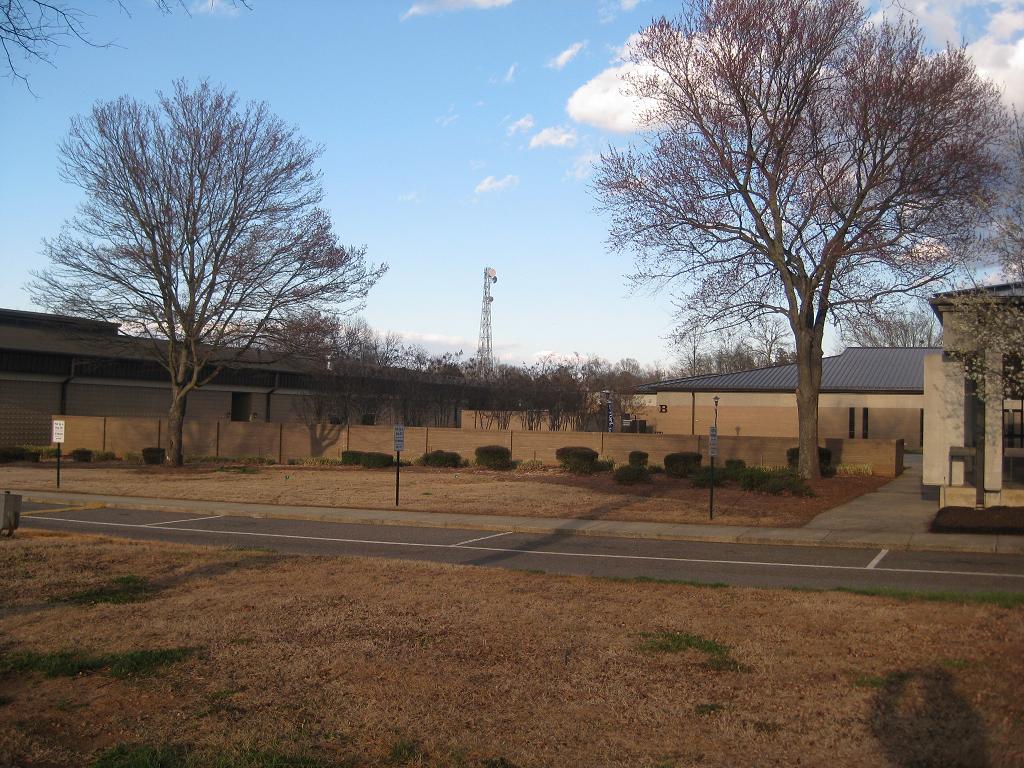 |
| Before |
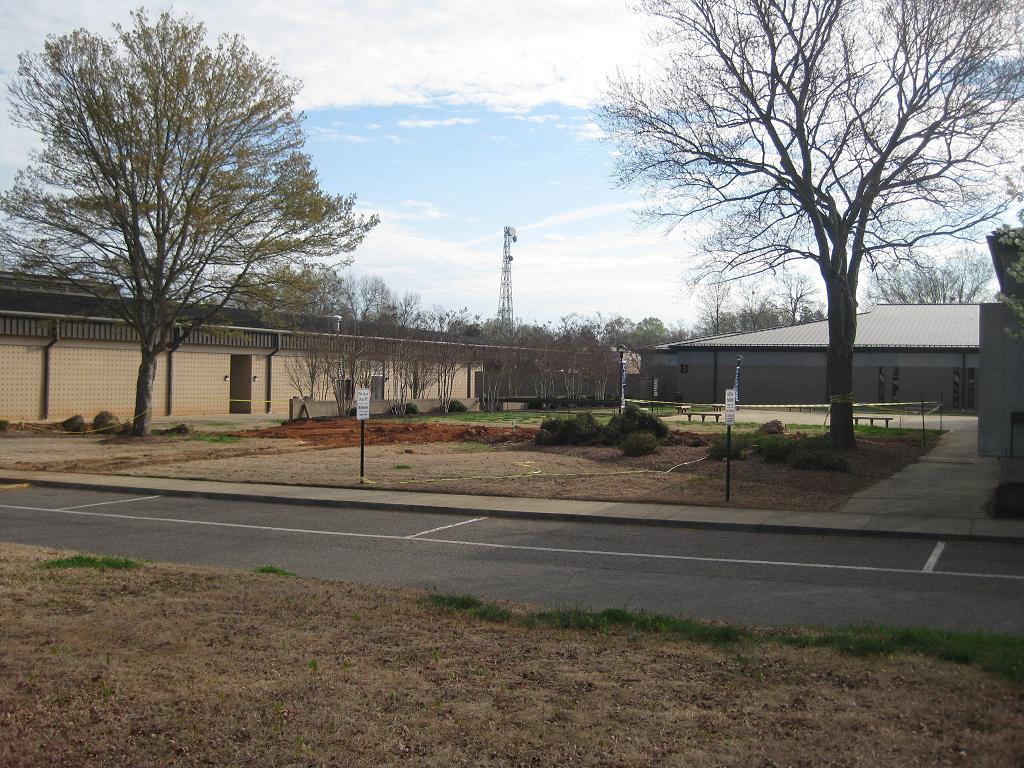 |
| After |
One of the goals for our Campus Master Plan is to have a pedestrian-focused campus core. The first step to creating this will be the development of our major pedestrian corridors, one of which is the east-west corridor. This corridor runs from the eastern gateway, at the rear of campus near buildings F and G, to the west side of campus, towards Anderson Road. This corridor intersects nine of the 15 buildings on our campus and is frequently used by students, faculty, staff, and visitors. Currently, the western portion of this corridor, between buildings C and H (Administration building), is confined and enclosed by walls and utility infrastructure. The College’s goal is to remove these barriers as we implement the Campus Master Plan and create a more inviting campus with universal access. The first step in the implementation process is to remove several walls located around the plaza between buildings C and H. During spring break, a large portion of this wall system was removed. Many thanks to Robby Brown, James Reeves, Roy Polk, and their staff for making this happen! Over the next several weeks, the area where the wall once stood will be re-landscaped to create a more open space, providing better visibility in the area. There will be interim landscaping performed by our grounds department to tie the two spaces together. As we develop our central energy plant, eventually the utility infrastructure will be removed, which will provide full access to the east-west corridor. There are also future plans to enhance the plaza area to provide additional outdoor collaborative learning space and possibly a signature water feature.
 |
| Before |
 |
| After |
In addition, over the next six-eight weeks the College will add landscape improvements to Hood Center Drive (from Baskins Road to Garrison Road). These improvements are part of our Campus Master Plan and coincide with the development of our loop road system and eastern gateway to the campus. These improvements will require the use of the roadway at times for the contractor to off-load equipment and plants. Please use caution as you travel this roadway so that our contractor crews may work safely in these areas.
Tuesday, March 20, 2012
Faculty Recognition

Last year, John was the recipient of the President’s Award for Excellence at York Tech’s 2011 graduation. John is passionate about his work and the success of his students. He continuously looks for new and creative teaching methods to engage his students. We are very proud of John and all his accomplishments!
Wednesday, March 7, 2012
More great things happening at York Tech…..
Please read some of our most recent news items, published by our Marketing and Public Information Office, by clicking on the below headings.
York Tech Students Recognized for Promoting Art Awareness
Congratulations to our Phi Theta Kappa chapter for receiving second place in the 2012 SCTEA Student Community Involvement Project!
SCTEA Recognizes York Tech Educators of the Year
Congratulations Dr. Jack Bagwell, Jyron Baxter, and T’rone Gibson for being recognized as York Tech’s Educators of the Year.
York Tech’s Bobby Plair Receives Community Service Merit Award
Is that Bobby and Glen the Frog? It is! Congratulations, Bobby, for all your work in the community and being one of six recipients of the Community Service Merit Award.
I am so proud of our students, faculty, and staff! I am grateful for all that you do!
York Tech Students Recognized for Promoting Art Awareness
Congratulations to our Phi Theta Kappa chapter for receiving second place in the 2012 SCTEA Student Community Involvement Project!
SCTEA Recognizes York Tech Educators of the Year
Congratulations Dr. Jack Bagwell, Jyron Baxter, and T’rone Gibson for being recognized as York Tech’s Educators of the Year.
York Tech’s Bobby Plair Receives Community Service Merit Award
Is that Bobby and Glen the Frog? It is! Congratulations, Bobby, for all your work in the community and being one of six recipients of the Community Service Merit Award.
I am so proud of our students, faculty, and staff! I am grateful for all that you do!
Wednesday, February 29, 2012
YTC LEAD
The College and our surrounding environment is constantly changing. I have said many times that we must continuously evaluate the way we do business in order to thrive in today’s economy. The reVIEW program and the Operations Excellence (OpEx) program both support our efforts to evaluate and improve our business processes. We all have a part in the improvement process! However, in order to truly transform the organization into the best it can be, we must transform ourselves into better leaders. We all have the opportunity and responsibility to make a difference. One of the many books I have read, The Leadership Challenge, summarizes the patterns of behavior in individuals who exhibit exemplary leadership.
• Model the Way – Establish principles concerning the way people should be treated and the way goals should be pursued
• Inspire a Shared Vision –Passionately believe you can make a difference
• Challenge the Process – Search for opportunities to change the status quo
• Enable Others to Act – Foster collaboration and build spirited teams
• Encourage the Heart – Recognize contributions that individuals make
Regardless of your position in the organization, I believe we can all work on the behaviors mentioned above in order to Be Real, Be Bold, and Be Better – for ourselves, our coworkers, our partners, and for our students! To assist in this endeavor, we launched the YTC LEAD program in December and will be offering a leadership speakers series for all employees in the near future. The YTC LEAD inaugural cohort includes Jyron Baxter, Ivan Lowe, John McGill, Mike Brumbach, Jamey Abercrombie, Chris Cimino, Nikisha Dawkins, Brenda Odom, Ginger Dewey, Michele Wells, Michael McAllister, and Stacy Scott. I’d like to thank Edwina Roseboro-Barnes, Kathy Hoellen, Monique Perry, and Laura Sturgis for helping develop the YTC LEAD program.
Just as a reminder, one of our strategic themes, Organizational Development, resulted from the 650 inputs received from faculty and staff. I believe the YTC LEAD program, among other professional development opportunities, will help better support our efforts to be better than we have to be. Remember – organizations do nothing, technology does nothing, PEOPLE do everything!
• Model the Way – Establish principles concerning the way people should be treated and the way goals should be pursued
• Inspire a Shared Vision –Passionately believe you can make a difference
• Challenge the Process – Search for opportunities to change the status quo
• Enable Others to Act – Foster collaboration and build spirited teams
• Encourage the Heart – Recognize contributions that individuals make
Regardless of your position in the organization, I believe we can all work on the behaviors mentioned above in order to Be Real, Be Bold, and Be Better – for ourselves, our coworkers, our partners, and for our students! To assist in this endeavor, we launched the YTC LEAD program in December and will be offering a leadership speakers series for all employees in the near future. The YTC LEAD inaugural cohort includes Jyron Baxter, Ivan Lowe, John McGill, Mike Brumbach, Jamey Abercrombie, Chris Cimino, Nikisha Dawkins, Brenda Odom, Ginger Dewey, Michele Wells, Michael McAllister, and Stacy Scott. I’d like to thank Edwina Roseboro-Barnes, Kathy Hoellen, Monique Perry, and Laura Sturgis for helping develop the YTC LEAD program.
Just as a reminder, one of our strategic themes, Organizational Development, resulted from the 650 inputs received from faculty and staff. I believe the YTC LEAD program, among other professional development opportunities, will help better support our efforts to be better than we have to be. Remember – organizations do nothing, technology does nothing, PEOPLE do everything!
Tuesday, February 21, 2012
The winner is......
Last year, artists and designers across the nation submitted their work to be considered as one of the official posters for the 2012 Democratic National Convention. After 400 submissions and over 26,000 votes, the winner was announced recently by the mayor of Charlotte, Anthony Foxx. I am delighted to tell you that our very own Steve Ward is the winner of the official poster contest for the 2012 Democratic National Convention. Steve is a digital design instructor at York Tech and a graduate from UNC-Charlotte. His poster titled “Urban Unity” shows the Charlotte skyline and with clasping hands showing the importance of people coming together for a common cause. We are very proud of Steve and his accomplishment!
“Urban Unity” was designed to celebrate diversity. We all have different political, economic, and religious views, but that's what makes this country so special. Too often political arenas are used to shun other's way of thinking and promote their own. We should all come together, unified, with ears and minds open. Steve Ward
 |
| "Urban Unity" |
“Urban Unity” was designed to celebrate diversity. We all have different political, economic, and religious views, but that's what makes this country so special. Too often political arenas are used to shun other's way of thinking and promote their own. We should all come together, unified, with ears and minds open. Steve Ward
Tuesday, February 14, 2012
QEP Impact Report Accepted!
I am proud to announce that the Quality Enhancement Plan (QEP) Impact Report submitted to the Southern Association of Colleges and Schools Commission on Colleges (SACS COC) in the fall of 2011 has been accepted! The Committee reviewing the report noted, “The Quality Enhancement Plan Impact Report adequately and appropriately addressed all the required elements in the Report. The QEP dealt with critical thinking across the curriculum. The project was an ambitious undertaking, with strong institutional buy-in. The assessments of the outcomes were adequately documented and on target. The institution is to be applauded for the success and the commitment to the QEP.”
We could not have asked for a better response. I want to thank Dr. Jack Bagwell and Taunya Paul for their leadership and the ACTiON Team members Chris Cimino, Martin Grant, Ed Moore, Shelly Myers, Sue Tatro, and Michele Wells for all their hard work on the QEP initiatives! All faculty and staff are to be commended for a job well done for their work on improving students’ critical thinking skills as part of the QEP!
We could not have asked for a better response. I want to thank Dr. Jack Bagwell and Taunya Paul for their leadership and the ACTiON Team members Chris Cimino, Martin Grant, Ed Moore, Shelly Myers, Sue Tatro, and Michele Wells for all their hard work on the QEP initiatives! All faculty and staff are to be commended for a job well done for their work on improving students’ critical thinking skills as part of the QEP!
Tuesday, February 7, 2012
A Place to Gather.....
.jpg) |
| Before |
Have you seen our new outdoor space on campus? If you haven’t had a chance, please stop by the area between A-building and B-building at your convenience. In our desire to create a more inviting campus, a beautifully landscaped outdoor space, with tables, chairs, and umbrellas, has been established for faculty, staff, and students to gather, learn, socialize, and eat. Your feedback in the planning process helped bring this concept to fruition.
The reality of this outdoor space is just the beginning of Phase I of the Campus Master Plan. The Plan also establishes a Learning Commons that will essentially serve as the hub of campus and will house the library, bookstore, learning support, private study areas, group collaboration areas, and a substantial food service operation. The purpose of the Learning Commons is to create an atmosphere of community and a place for students and employees to gather.
 |
After |
I will keep you abreast as we move forward on Phase 1 of the Campus Master Plan. Enjoy our new outdoor gathering space!
Thursday, February 2, 2012
Accelerate Student Success
Last week, I had the pleasure of meeting with the Acceleration Team. At our first meeting we had a very open and honest conversation around the input received from the all-faculty August 22 meeting. My goal in this process is to listen, ask questions, and to the best of my ability fully understand perspectives so that I can better communicate with other faculty and staff. The Team will continue to meet over the next couple of months to further explore strategies and tools we can use to further our goal of Maximizing Student Success and to address the following research question: How can we (as an institution) accelerate student success through the classroom experience without adding additional work to faculty? The Team will be looking for your perspectives on issues that we discuss in our meetings, as well. Members of the Acceleration Team, appointed by peers, include:
Pete Baldwin - Business, Computer, Arts, and Sciences (BCAS)
Jonathon Stewart - Industrial and Engineering Technologies (IET)
Debbie Tertinger - Health and Human Services (HHS)
Krista Bradshaw – Center for Teaching and Learning (CTL)
Linda Bolick - Corporation and Continuing Education (CCE)
Steven Rast - Adjunct Faculty
Sally Herlong and Kerri McGuire - Student Services (SS)
Pete Baldwin - Business, Computer, Arts, and Sciences (BCAS)
Jonathon Stewart - Industrial and Engineering Technologies (IET)
Debbie Tertinger - Health and Human Services (HHS)
Krista Bradshaw – Center for Teaching and Learning (CTL)
Linda Bolick - Corporation and Continuing Education (CCE)
Steven Rast - Adjunct Faculty
Sally Herlong and Kerri McGuire - Student Services (SS)
Tuesday, November 15, 2011
Acceleration Team
On August 22, I met with faculty to talk candidly about student success. I asked faculty for input related to the following four questions:
• What are the top three challenges you face as faculty members in trying to pursue student success?
• How do we best measure student performance?
• If you were on my board, what criteria would you use to measure my performance?
• How do you believe your performance should be measured?
I want to thank all of the faculty for participating in the faculty meeting. As a follow-up, a 90-day Acceleration Team will be created whose goal will be to gain a deeper understanding of the feedback received and to identify value-added actionable and sustainable strategies that maximize classroom time and directly impact student success. Classroom instruction is the most influential time we have with our students. We must have an unrelenting focus on maximizing every moment of instructional time. The Acceleration Team will research and make recommendations to address the following research questions: How can we (as an institution) accelerate student success through the classroom experience without adding additional work to faculty? The Acceleration Team’s outcomes will be presented to the Executive Committee and Council for Academic and Student Affairs (CASA). The Team will consist of faculty (teaching) from the BCAS, CCE, HHS, and IET divisions. The Student Services and Center for Teaching and Learning staff are a vital part of supporting our student success efforts in the classroom and will be involved as well. However, this will be a faculty driven Team. Faculty from each division will appoint one faculty member from their respective division (BCAS, CCE, HHS, and IET) by November 29. Additional faculty may be appointed at a later time to further represent the divisions.
Team members must exhibit a high level of maturity and critical thinking and must be able to exemplify the following principles:
• Be proactive versus reactive
• Focus on responsibility versus blame
• Listen first to understand before being understood
• Focus on growing circle of influence, not circle of concern
• Agree to disagree and seek win/win agreement
• Apply the abundance mentality versus scarcity
• Be innovative
• Build meaningful professional relationships
Team members will be asked to seek and gain understanding of their own perspectives, perspectives of the workplace, and the community of practice through specific readings, viewings, and other data points relevant to the discovery process. Team members will be required to develop and deliver powerful and concise presentations to solicit feedback regarding the proposed recommendations/outcomes. The Acceleration Team will begin meeting the first week of December and will meet at various times over the 90-day period which will conclude in late February or early March.
I look forward to working with the Team through the discovery process to learn what strategies and tools we can use to further our goal of Maximizing Student Success.
• What are the top three challenges you face as faculty members in trying to pursue student success?
• How do we best measure student performance?
• If you were on my board, what criteria would you use to measure my performance?
• How do you believe your performance should be measured?
I want to thank all of the faculty for participating in the faculty meeting. As a follow-up, a 90-day Acceleration Team will be created whose goal will be to gain a deeper understanding of the feedback received and to identify value-added actionable and sustainable strategies that maximize classroom time and directly impact student success. Classroom instruction is the most influential time we have with our students. We must have an unrelenting focus on maximizing every moment of instructional time. The Acceleration Team will research and make recommendations to address the following research questions: How can we (as an institution) accelerate student success through the classroom experience without adding additional work to faculty? The Acceleration Team’s outcomes will be presented to the Executive Committee and Council for Academic and Student Affairs (CASA). The Team will consist of faculty (teaching) from the BCAS, CCE, HHS, and IET divisions. The Student Services and Center for Teaching and Learning staff are a vital part of supporting our student success efforts in the classroom and will be involved as well. However, this will be a faculty driven Team. Faculty from each division will appoint one faculty member from their respective division (BCAS, CCE, HHS, and IET) by November 29. Additional faculty may be appointed at a later time to further represent the divisions.
Team members must exhibit a high level of maturity and critical thinking and must be able to exemplify the following principles:
• Be proactive versus reactive
• Focus on responsibility versus blame
• Listen first to understand before being understood
• Focus on growing circle of influence, not circle of concern
• Agree to disagree and seek win/win agreement
• Apply the abundance mentality versus scarcity
• Be innovative
• Build meaningful professional relationships
Team members will be asked to seek and gain understanding of their own perspectives, perspectives of the workplace, and the community of practice through specific readings, viewings, and other data points relevant to the discovery process. Team members will be required to develop and deliver powerful and concise presentations to solicit feedback regarding the proposed recommendations/outcomes. The Acceleration Team will begin meeting the first week of December and will meet at various times over the 90-day period which will conclude in late February or early March.
I look forward to working with the Team through the discovery process to learn what strategies and tools we can use to further our goal of Maximizing Student Success.
Monday, November 7, 2011
Student Success and Financial Goals
As you review our Student Success Rates graph, notice that we are making progress towards achieving our stretch goal of 70 percent fall to fall retention. Our new goal for next year is 62 percent for fall to fall. We all have a part in achieving this goal - from the employees that help beautify our campus, to the employees that provide student support services, to the faculty that engage our students every day in the classroom. We have achieved so much since our planning sessions in 2007-2008. If you look at your input from those sessions, you can really see the progress we have made. However, there is much to be done and I know we can achieve even greater things together.
I am excited to have Dr. Julie Phelps, mathematics instructor and project director for Achieve the Dream at Valencia College, to speak to us at our annual employee recognition luncheon on December 20. Dr. Phelps has studied ways to increase student engagement, learning, retention, and graduation among developmental education students. The December 20 meeting will begin at 10 a.m. for all faculty and staff and a special faculty session will be held after lunch. More information about her visit will be sent via e-mail. Please save the date – December 20!
I previously mentioned a financial goal too. As we create greater efficiencies and effectiveness, we should improve our financials too. We have set a goal of $1.5 million in addition to net assets by June 30, 2012. We have developed a financial model that projects the College will need $76 million over the next five years in order to meet our future programming needs, IT infrastructure, deferred maintenance, and phase I and II of the Campus Master Plan. We must continue to reevaluate our business processes and work smarter in order to achieve greater efficiencies to meet our financial goals.
Job placement rates are becoming increasingly important for us to use as a measure of success. For the past three years, we have scored below the system average. This year, we will evaluate our current tracking mechanisms and will set a goal next year.
Again, I am grateful for all your hard work and ask you to Be Real, Be Bold, and Be Better! Remember, organizations do nothing, plans do nothing, technology does nothing, people do everything!
I am excited to have Dr. Julie Phelps, mathematics instructor and project director for Achieve the Dream at Valencia College, to speak to us at our annual employee recognition luncheon on December 20. Dr. Phelps has studied ways to increase student engagement, learning, retention, and graduation among developmental education students. The December 20 meeting will begin at 10 a.m. for all faculty and staff and a special faculty session will be held after lunch. More information about her visit will be sent via e-mail. Please save the date – December 20!
I previously mentioned a financial goal too. As we create greater efficiencies and effectiveness, we should improve our financials too. We have set a goal of $1.5 million in addition to net assets by June 30, 2012. We have developed a financial model that projects the College will need $76 million over the next five years in order to meet our future programming needs, IT infrastructure, deferred maintenance, and phase I and II of the Campus Master Plan. We must continue to reevaluate our business processes and work smarter in order to achieve greater efficiencies to meet our financial goals.
Job placement rates are becoming increasingly important for us to use as a measure of success. For the past three years, we have scored below the system average. This year, we will evaluate our current tracking mechanisms and will set a goal next year.
Again, I am grateful for all your hard work and ask you to Be Real, Be Bold, and Be Better! Remember, organizations do nothing, plans do nothing, technology does nothing, people do everything!
Thursday, October 27, 2011
Why Reward?
In my recent email about compensation enhancements, I stressed the delicate balance and positive implications of meeting both our student performance goals and our financial goals in order to be sustainable. I am now asking you to read and think about how and why there will be compensation enhancements in the future and, for that matter, why there is compensation at all.
I believe that successful academics and successful economics are inextricably linked. It’s like an ecosystem. At the risk of being seen as a cosmologic nut, consider the T’ai Chi symbol or Yin and Yang. Please give me the benefit of the doubt and read this excerpt on the subject from my dissertation:
YIN, YANG, AND HEGEL
The concept of Yin and Yang has its roots in Chinese cosmology and is represented by the familiar Yin/Yang symbol called the T’ai Chi. This symbol, pictured in Figure 1, shows the interrelatedness between the two parts. Yin is represented by the dark portion and Yang by the light. These are seen as equal opposites always in a cyclical balance, as one increases the other decreases. Within each is the seed of the other, represented by the light and dark dots, each found in the fullness of the other. This representation says that one part cannot exist without the other. The significance of this balance was stressed by many Chinese philosophers who believed this symbolism was played out in life, determining social and political harmony. Believed to represent the great forces of the universe, the T’ai Chi is seen as the perfect balance between opposites. Both are together in one circle revealing that both powers form one cycle. The relationship of Yin and Yang is not antagonistic. The two are together, separate, yet forming one circle revealing their mutual interdependence. This concept is also found in the dialectic worldview, where as any force reaches its extreme it becomes its opposite. The presumption being that any particular reality is formed by the interaction of two opposites. The result is not that of one force or the other but the synergistic and complimentary balance of both (Anonymous, 2002, Ehman, 1996, 168 Feng Shui Advisors, 2002, Microsoft, 2002).
As I am fond of saying, “bottom line,” we must meet our financial AND our student performance goals in order to be sustainable. That’s a simple statement with lots of detail in the background. Our primary role is in helping our students in increasing their economic and social value to society. When they COMPLETE with us, they must be able to do what it is that we say they can do and know what it is that we say they should know. Anything less is unacceptable. In order for them to complete, they either have to stay on course here or transfer somewhere else. As we have discussed, ad nauseam, some related factors we control and others we do not. We are, and have been, working on those factors we can control. If we do a good job and create greater efficiencies and effectiveness, we should, through strategic and tactical execution, improve our financial footings as well.
Now, most of us have to work in order to have housing, food, clothing, health insurance, future retirement, etc. Many of us could choose other occupations and possibly even make more money. If you have studied psychology, you are aware that there are intrinsic (i.e. personal fulfillment and joy) rewards and that there are extrinsic (i.e. financial) rewards. With most people, neither reward alone can sustain us. Remember Maslow’s Hierarchy of Needs? There is a base of mostly extrinsic items but as we move up his pyramid, rewards become more intrinsic in nature but they still rely on the extrinsic.
Next year, the bar will be raised. I will share our future goals in my next blog post. The old EPMS/FPMS performance system that you love SO much (sarcasm intended) will change dramatically, I think, for the better. It will be less laborious and focus on value-added; more to come on that later.
I believe that successful academics and successful economics are inextricably linked. It’s like an ecosystem. At the risk of being seen as a cosmologic nut, consider the T’ai Chi symbol or Yin and Yang. Please give me the benefit of the doubt and read this excerpt on the subject from my dissertation:
 |
| Figure 1 - The T'ai Chi |
The concept of Yin and Yang has its roots in Chinese cosmology and is represented by the familiar Yin/Yang symbol called the T’ai Chi. This symbol, pictured in Figure 1, shows the interrelatedness between the two parts. Yin is represented by the dark portion and Yang by the light. These are seen as equal opposites always in a cyclical balance, as one increases the other decreases. Within each is the seed of the other, represented by the light and dark dots, each found in the fullness of the other. This representation says that one part cannot exist without the other. The significance of this balance was stressed by many Chinese philosophers who believed this symbolism was played out in life, determining social and political harmony. Believed to represent the great forces of the universe, the T’ai Chi is seen as the perfect balance between opposites. Both are together in one circle revealing that both powers form one cycle. The relationship of Yin and Yang is not antagonistic. The two are together, separate, yet forming one circle revealing their mutual interdependence. This concept is also found in the dialectic worldview, where as any force reaches its extreme it becomes its opposite. The presumption being that any particular reality is formed by the interaction of two opposites. The result is not that of one force or the other but the synergistic and complimentary balance of both (Anonymous, 2002, Ehman, 1996, 168 Feng Shui Advisors, 2002, Microsoft, 2002).
As I am fond of saying, “bottom line,” we must meet our financial AND our student performance goals in order to be sustainable. That’s a simple statement with lots of detail in the background. Our primary role is in helping our students in increasing their economic and social value to society. When they COMPLETE with us, they must be able to do what it is that we say they can do and know what it is that we say they should know. Anything less is unacceptable. In order for them to complete, they either have to stay on course here or transfer somewhere else. As we have discussed, ad nauseam, some related factors we control and others we do not. We are, and have been, working on those factors we can control. If we do a good job and create greater efficiencies and effectiveness, we should, through strategic and tactical execution, improve our financial footings as well.
Now, most of us have to work in order to have housing, food, clothing, health insurance, future retirement, etc. Many of us could choose other occupations and possibly even make more money. If you have studied psychology, you are aware that there are intrinsic (i.e. personal fulfillment and joy) rewards and that there are extrinsic (i.e. financial) rewards. With most people, neither reward alone can sustain us. Remember Maslow’s Hierarchy of Needs? There is a base of mostly extrinsic items but as we move up his pyramid, rewards become more intrinsic in nature but they still rely on the extrinsic.
Next year, the bar will be raised. I will share our future goals in my next blog post. The old EPMS/FPMS performance system that you love SO much (sarcasm intended) will change dramatically, I think, for the better. It will be less laborious and focus on value-added; more to come on that later.
Tuesday, October 18, 2011
The Apple of Technical/Community Colleges
In reading an article about Steve Jobs, I came across the following statement:
“The lessons we could learn from Steve Jobs aren’t all that remarkable. Many of them contain wisdom that we already know – we just don’t apply it. Why not? Is it that we lack courage? Or is it that we find it hard to believe that tenets so simple can prove so effective? Surely that’s the moral of the Apple story: there is genius in simplicity. But simple is hard.”
In my mind, what we are trying to achieve at York Tech is no different than what Jobs was trying to achieve at Apple. Providing people a product/experience like none other. Our efforts to improve the student success rates and the experience at York Technical College for students seems so simple yet so difficult! So, what can we learn from Steve Jobs’ achievements and those of his team?
1. Be Real
Steve Jobs was true to himself. He believed in his vision and the courage to change the world. Jobs and his creative team made Apple the most influential and valuable corporations in the world. And one way to see the measure of the value they created is by tracking the stock price of Apple from 1997, when Jobs returned to Apple, to its peak. We too should be true to ourselves and to others. As I have said previously, being real doesn’t mean telling people whatever is on your mind or being unprofessional, but rather, helping real people navigate through the real world. Real people care, are appropriately vulnerable, and separate themselves from the noise to focus on the goal. We should try to better understand students, fellow employees, and ourselves in an effort to help us all improve.
2. Be Bold
Steve Jobs dared to think differently. He pushed the envelope in product design and is now known as one of the greatest inventors of our time. He imagined the unimaginable and will inspire generations to come. What would happen if we perceived no limits to our success; if we were unafraid to step outside our box, daring to expand the horizon of possibility? Being bold means taking personal responsibility and being a value-added part of the whole. Thoughtfully stepping up to solve problems and exemplifying what we represent. We should take personal responsibility for adding value.
3. Be Better
Steve Jobs designed products better than they had to be. Even when he failed, he learned from those failures and tried again. If we never try, we’ll never get it right. In the words of Sir Ken Robinson, “Now, I don’t mean to say that being wrong is the same thing as being creative. But what we do know is that if you are not prepared to be wrong you will never come up with anything original.” Be Better means striving to continuously improve. The very core of our mission is about helping people learn, grow, and achieve. We desire that for our students and ourselves as we seek to better the community we serve. We must be better than we have to be!
Together, we can be the Apple of Technical/Community Colleges. Be Real, Be Bold, Be Better!
“The lessons we could learn from Steve Jobs aren’t all that remarkable. Many of them contain wisdom that we already know – we just don’t apply it. Why not? Is it that we lack courage? Or is it that we find it hard to believe that tenets so simple can prove so effective? Surely that’s the moral of the Apple story: there is genius in simplicity. But simple is hard.”
In my mind, what we are trying to achieve at York Tech is no different than what Jobs was trying to achieve at Apple. Providing people a product/experience like none other. Our efforts to improve the student success rates and the experience at York Technical College for students seems so simple yet so difficult! So, what can we learn from Steve Jobs’ achievements and those of his team?
1. Be Real
Steve Jobs was true to himself. He believed in his vision and the courage to change the world. Jobs and his creative team made Apple the most influential and valuable corporations in the world. And one way to see the measure of the value they created is by tracking the stock price of Apple from 1997, when Jobs returned to Apple, to its peak. We too should be true to ourselves and to others. As I have said previously, being real doesn’t mean telling people whatever is on your mind or being unprofessional, but rather, helping real people navigate through the real world. Real people care, are appropriately vulnerable, and separate themselves from the noise to focus on the goal. We should try to better understand students, fellow employees, and ourselves in an effort to help us all improve.
2. Be Bold
Steve Jobs dared to think differently. He pushed the envelope in product design and is now known as one of the greatest inventors of our time. He imagined the unimaginable and will inspire generations to come. What would happen if we perceived no limits to our success; if we were unafraid to step outside our box, daring to expand the horizon of possibility? Being bold means taking personal responsibility and being a value-added part of the whole. Thoughtfully stepping up to solve problems and exemplifying what we represent. We should take personal responsibility for adding value.
3. Be Better
Steve Jobs designed products better than they had to be. Even when he failed, he learned from those failures and tried again. If we never try, we’ll never get it right. In the words of Sir Ken Robinson, “Now, I don’t mean to say that being wrong is the same thing as being creative. But what we do know is that if you are not prepared to be wrong you will never come up with anything original.” Be Better means striving to continuously improve. The very core of our mission is about helping people learn, grow, and achieve. We desire that for our students and ourselves as we seek to better the community we serve. We must be better than we have to be!
Together, we can be the Apple of Technical/Community Colleges. Be Real, Be Bold, Be Better!
Tuesday, October 11, 2011
Welcome New Employees
Several new employees have joined the York Tech family in the past few months. Below are just a few of the new faces on campus.
Leah is originally from central Florida and has lived in Charlotte for the past ten years. She received her B.S. in Finance and an M.S. in Mathematics from UNC Charlotte. Prior to graduate school, Leah worked as a financial analyst for a healthcare consulting firm. Leah replaces Nasser Navidar.
A former honor graduate of York Technical College, Andie has helped tutor our OST/AOT classes and assisted in the keyboarding and open labs. Andie is a Who’s Who for Two-Year Colleges and a Governor’s Career Award recipient. Before joining the Corporate and Continuing Education division, Andie worked part-time in the Student Support Services department. Andrea replaces Levonne McCullough who retired earlier this year.
Welcome to York Tech – Leah, Jennifer, and Andie!
 |
Leah Hollingsworth Mathematics Instructor |
Jennifer has a B.S. in Biology from Winthrop University and a Ph.D. in Molecular Biology from the University of South Carolina. She spent the last four years working in Molecular Diagnostic laboratories including the Greenwood Genetic Center (Greenwood, SC) and the Molecular Pathology Laboratory within Carolinas Healthcare System (Charlotte, NC). Jennifer replaces Bruce Romein who retired earlier this year.
 |
| Jennifer Morgan Biology Instructor |
 |
| Andrea (Andie) Wray Administrative Specialist, Corporate and Continuing Education |
Welcome to York Tech – Leah, Jennifer, and Andie!
More new employee announcements coming soon….
Tuesday, October 4, 2011
New Outdoor Collaborative Learning Space
Next week we will begin work on a new outdoor collaborative learning space. The area between A-building and B-building will transform into a beautifully landscaped area for faculty, staff, and students to gather. The inviting, informal space will support our efforts to promote collaboration not only inside the classroom but outside as well. Thanks to employee input from the 2007 listening sessions and Campus Master Plan visioning sessions, we are making this concept a reality.
A portion of the parking lot between the Administration Building and A-building will be closed off to allow for the construction contractor to bring in equipment and materials. Handicap parking spaces will still be available and appropriate ramps will be added in the interim. Pedestrian traffic will be routed around the construction area. Our goal is to have construction completed by early December.
Thank you for your understanding as we continue our efforts to enhance the campus environment.
A portion of the parking lot between the Administration Building and A-building will be closed off to allow for the construction contractor to bring in equipment and materials. Handicap parking spaces will still be available and appropriate ramps will be added in the interim. Pedestrian traffic will be routed around the construction area. Our goal is to have construction completed by early December.
Thank you for your understanding as we continue our efforts to enhance the campus environment.
Friday, July 22, 2011
Welcome New Employees
I’d like to introduce to you three new employees to the York Tech family.
 Teresa Faile joined the College on June 1 as an Administrative Assistant in the Center for Teaching and Learning. Teresa is a native of Lancaster and has lived in Rock Hill for the past 26 years. She previously worked at Premier, Inc. in Charlotte, NC for 18 years. Teresa is a graduate of York Technical College, where she received an Associate Degree in Computer Programming and an Associate Degree in Secretarial Science. Teresa also received a Bachelor of Science in Business Administration/Management from Limestone College.
 Brittany Burton, Employment Coordinator in Human Resources, joined the York Tech family on July 1. Brittany is a native of Columbia, SC. Her previous work experience includes the SC Department of Health and Human Services as a Program Assistant and the SC Department of Probation, Pardon, and Parole Services as a Training Coordinator in Human Resources Development. She received a Bachelors in Business Administration in Management Information Systems from Francis Marion University and an Master of Arts in Conflict Management from Columbia College.
 Bree Robinson, Program Coordinator/Loan Counselor in Financial Aid, joined the College on July 1. Bree is a native of Darlington, SC. She previously worked as a Financial Aid Counselor at Central Carolina Technical College. Bree received a Bachelor of Arts from South Carolina State University and a Master of Arts from Webster University.
Welcome to York Tech – Teresa, Brittany, and Bree!


Welcome to York Tech – Teresa, Brittany, and Bree!
Tuesday, July 19, 2011
New Commission Member

Ms. Douglass is a Fellow of the American College of Healthcare Executives. She is also a member of the York County Regional Chamber of Commerce Government Relations Task Force, Rock Hill Economic Development Committee Quality of Life Task Force, and serves on the Board of Directors Executive Committee for the Community Blood Centers of the Carolinas. She is a member of St. John’s United Methodist Church in Rock Hill.
Ms. Douglass replaces Ms. Carolyn Carpenter, who retired after 20 years of service to the College.
The other nine governing board seats are held by:
Mr. Charles Z. Robinson (Chair)
Human Resources Consultant, Prosperity Resources, LLC
Ms. Geri H. Rucker (Vice-Chair)
Regional Vice President, Founders Federal Credit Union
Mr. E. Paul Basha
President & CEO, York Electric Cooperative, Inc.
Mr. James “Jim” C. Hardin, III
Attorney at Law, James C. Hardin III, PLLC
Dr. A. Douglas “Doug” Marion
Ophthalmologist, Eye Associates of Chester, PA
Mr. Robert “Bobby” B. Meek
Owner, Century 21 Palmetto Homes Realty
Mr. Harry M. Miller
Executive Vice President for Planning and Development, Comporium Communications
Mr. Jeffrey C. Sigmon
President, JEFCO Communications
Mr. Bruce “Tony” A. Vaughan
Retiree
Subscribe to:
Posts (Atom)